Things Can Change . . . Eventually
A reflection on some attitudes from the not so distant past

I was deleting files from my overstuffed laptop hard drive recently and came across this debate I took part in from 2012. It was held at the Oxford Union, the place where future Tory MP’s have traditionally done their training.
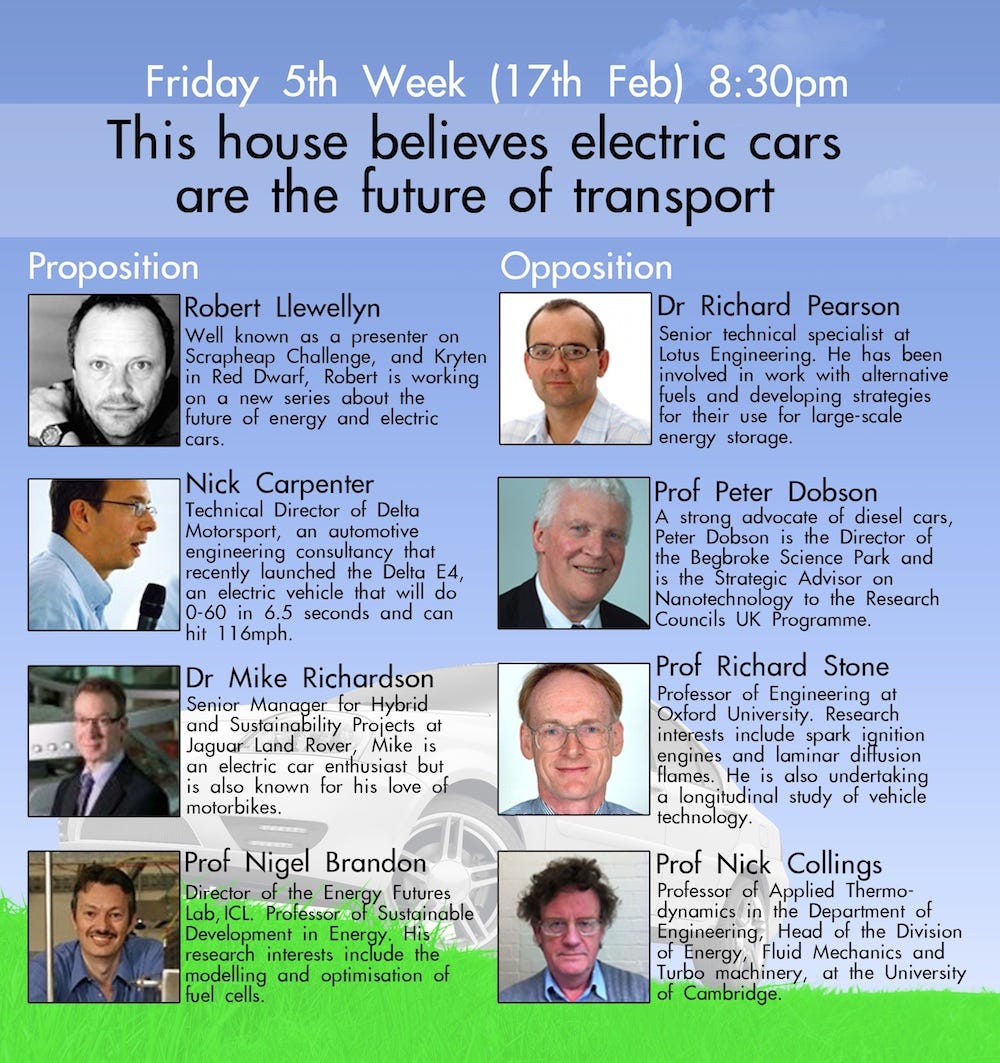
I can remember the event with unusual (for me) clarity. It was exciting but also very challenging. I knew I would be debating an incredibly complex topic and arguing with three clearly very well qualified professors with enormous experience and knowledge.
I knew my limitations, I knew how I would be perceived, a bloke who was expelled from school aged 16, a comedy actor off the telly, a loudmouth show off with near zero scientific or technical understanding.
I admit it was fairly intimidating, I’d never done anything like it before and I had no idea how to behave.
The opposing teams sit on long benches opposite each other, just like the political parties in the British Houses of Parliament. As I mentioned above, this is where the likes of David Cameron and Boris Johnson started their political careers, and many more before or since. Young toffs in evening dress, young men who have been told their entire lives that they are special and essentially better than the hoypoloi on the streets outside.

I can’t recall the exact format of the evening, other than I think we were meant to make our point in maybe 3 or 4 minutes followed by the cut and thrust of healthy disagreement. Or debate. I think there was a vote on the topic by the audience at the start and end of the debate. You know what, I’m fairly sure we won.
I note there were no women on either side, that would not be the case today. I can think of so many women now who would have made a much better job of arguing for electrification than I ever could. In 2012 electrification of ground transport was still a very niche topic, but it was one that had really caught the attention of the fossil fuel industry, their supporters, beneficiaries and acolytes.
What is remarkable to contemplate now is how the world has changed since those heady, golden years. Pre-Brexit and pre-Trumpy pants. the year the Olympics were held in London and everyone was happy to wave a Union Jack flag, you didn’t need to be an ignorant, racist bigot back then.
But they were also the years when the vast majority of people still thought internal combustion engines, importing oil from Russia, burning fossil fuel and ridiculing Chinese electric cars was the sensible option.
The thing is, back in 2012, they were more or less right. Electric cars were absurdly expensive, they cost way more than the equivalent fossil burners. No one, including the scientists that developed them and the companies making them, really knew how long a big battery pack in a car would last. Not only their lifespan but the cost.
In 2012, the cost of making 1 kiloWatt hour of battery storage was still around $950. An insane cost, utterly ridiculous, and there was no way of knowing how that might change.
Just for your understanding of the changes if you know nothing about such things, the cost of making 1 kiloWatt hour of battery storage in 2026 is between $40 and $90.
We now know that longevity of a battery pack is a problem. The problem is what do we do with the car it’s in. The car will have worn out and be falling to bits a decade or two before the battery might need refitting into a static storage array.
All car makers now give the battery pack a longer warranty than the car. You will never throw away the battery, a popular trope at the time started by the big, balding farmer Clarkson, you will throw away the car and use the battery somewhere else. Already happening.
But in 2012, none of this was even a pipe dream, all I knew was, burning 104 billion barrels of oil a day was probably not the best idea. Long term. All I knew was it might be worth exploring other ways of doing things, that didn’t require the human race to burn so much stuff.
The three professors on the opposite benches were all specialists in burning stuff, it was their raison d’etre, they knew an enormous amount about burning fuel, and they were very much in control of the argument and general public attitudes at the time.
They could dismiss electric vehicles with the mere flick of a wrist, they weren’t realistic machines, they were a distraction, a mere peice of middle class guilt ridden frippery.
After all, the industrial revolution, which started in this great country of ours, was literally built around burning stuff. Coal at first, then oil and most recently methane gas, sometimes wrongly referred to as ‘natural gas.’
I wish I had a video of this debate, I’d love to know what they said, what I said and what the two men on my side of the argument said. I can only guess that my arguments were weak and based on what I hoped might happen, I had very little hard evidence in 2012, just a gut feeling.
Were the same debate to take place today, with the massive disruption caused by the Epstein wars in and around Iran taking place, I have little doubt the tone of the debate would have shifted.
In 2012, there might have been 5 or 6,000 electric cars in the world, maybe not even that many.
Today there are over 100 million, of which around 40 million are scooters and mopeds, rickshaws and delivery vehicles. The number of electric vehicles expected to be manufactured this year will pass 30 million.
The number of enquiries that various car companies are receiving at the moment about their electric vehicle range has, anecdotally and according to three different sources I have spoken to, ‘gone off the scale,’ ‘gone insane’ and ‘I’ve never known anything like it and I’ve been in this business 45 years.’
This is not a passing phase, a brief fashion adopted by a few virtue signalling liberal tree huggers, this is a massive economic and technological transition which will, slowly, weaken the most powerful industry we’ve ever created.
You never know, it has been 14 years since I took part in that debate, in another 14 years the amount of oil we burn every day may have reduced, down from 104 billion barrels a day to a mere 50 billion. Maybe even less.
The writing is on the wall, the oil industry is not happy, they will fight back with a determination and a level of violence I don’t think any of us are prepared for. They own so many regimes and dictators around the world they will fight long, hard and dirty to maintain their power.
But they will lose.
The one very sad aspect of this memory is the wonderful Nick Carpenter, a lovely bloke, a brilliant engineer and very early proponent of the electrification of ground transport. Sadly Nick passed away a few years back. Much too young and a very sad loss.
This update is dedicated to him

You did have one advantage over all of them in the debate: You were probably best liked and most likable and funny person on the panel. That goes a long way in debates.
In the words of Hemmingway (on bankruptcy), "It happens very slowly and then all at once". It very much feels like the Epstein war has moved the EV uptake graph into the 'all at once' part.